

When the cell has a very important protein like Δ160p53 that can save its life under stress conditions, the cell wants to make sure the ribosome is not going to miss that start codon; so why not have two instead?

Read all the details in our new super exciting paper that is part of our also super exciting celebratory issue of the 40 years of p53 research. Click HERE!
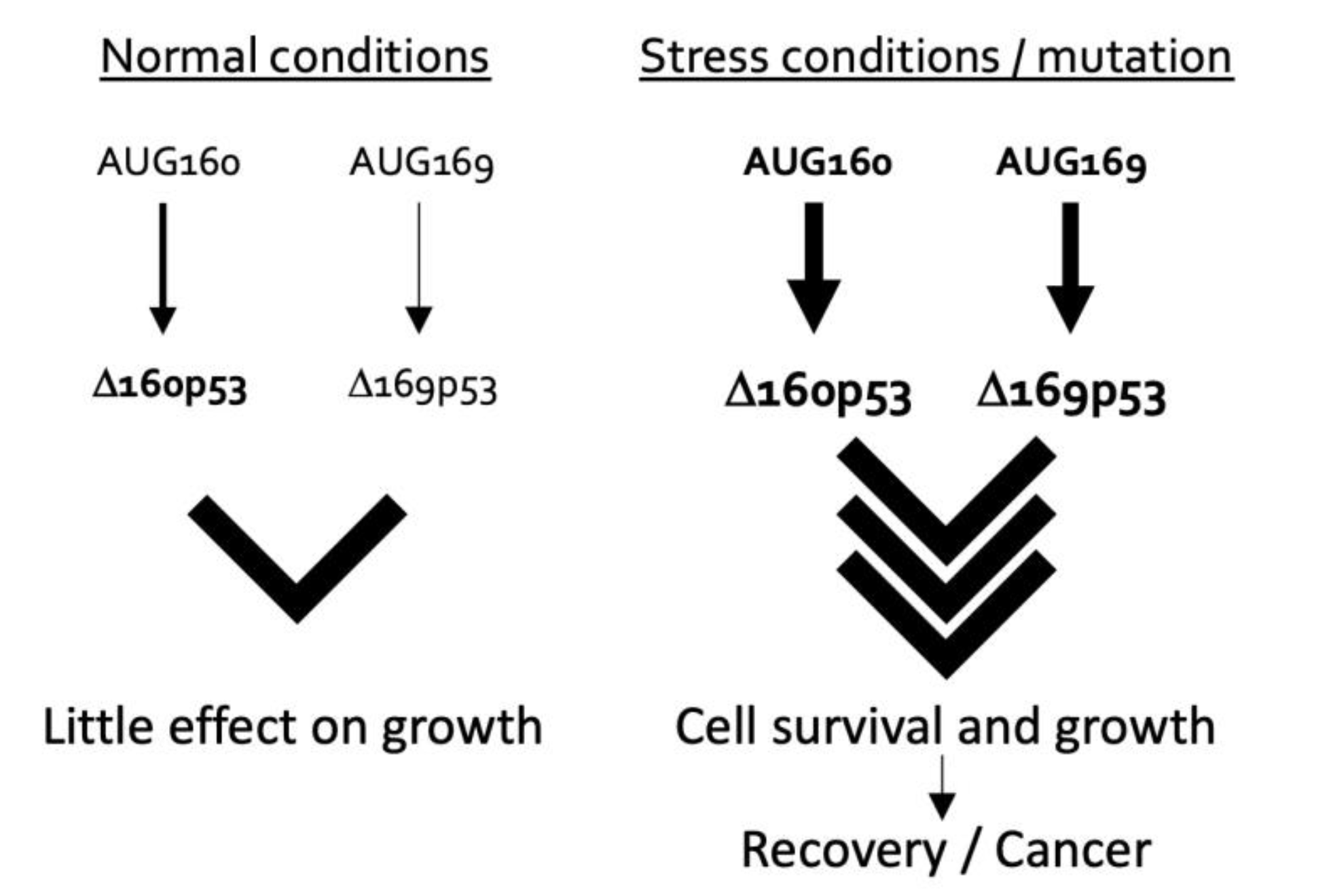
Figure 6C: “Under normal cell growth conditions AUG160 and AUG169 show low activity and there is low expression of the corresponding protein isoforms, but under stress conditions or with mutation each of these individual TIS becomes more active and initiate translation of the two protein forms, D160p53 and D169p53, [which are basically the same and] have equal capacity to induce cell growth and survival, and which could lead to recovery from stress or, in the case of continued activation, cancer formation or cancer development.”
[Video coming later – possibly]
 marco lab